
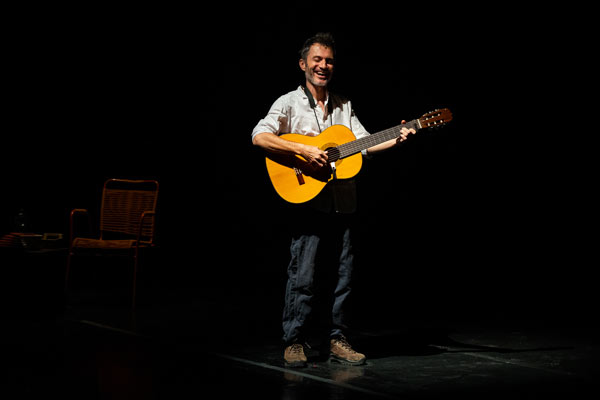
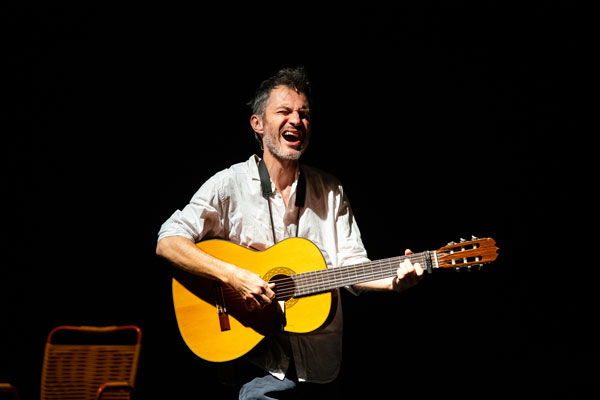
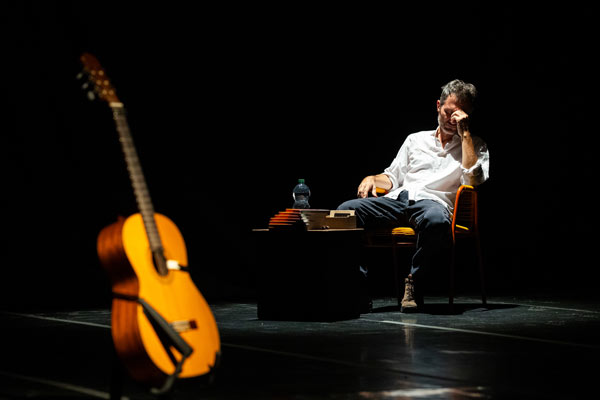
a performance by Alessandro Berti
curated by Gaia Raffiotta
produced by Casavuota
with the support of Sciaranuova festival and Teatro Comunale Laura Betti
photography by Francesco Bondi
“Italians are nigg*rs with short memories”—so declared Black rapper Chuck Nice in 2002, sparking controversy among Italian-American associations. But are these protests justified? Is it not true that, for decades, Italian emigrants occupied a middle ground between Black and white people, alongside Latinos and the Chinese?
The show traces part of this history: from alliances between Sicilian farmers and the children of enslaved Black people in Louisiana to the paradoxical influence of positivist anthropology on American ethnic classification laws; from the lynchings of Italian workers to the solidarity shown to African Americans by small anarchist circles; from the racist “iron fist” of police-chief-turned-mayor Frank Rizzo to educator Covello’s attempts to establish an interracial high school in New York; and finally to Frank Sinatra, who repeatedly had to confront the issue publicly—and in one instance, a little-known but illuminating episode recounted in the show, found himself unsure of how to navigate the situation.
Ne*ri senza memoria (Nigg*rs Without Memory) is a whirlwind monologue—rich in songs, facts, and stories—that navigates a vast body of historical material with stubborn ease, interpreting it and bringing to light previously unseen nuances. Free from prejudice and constantly emphasizing the complexity of the subject matter and the difficulty of passing judgment, the piece nonetheless sheds light on recurring themes in the relationship between Italian Americans and African Americans: the tendency of Italians to avoid taking an overly open stand, the contrast between private solidarity and public indifference, and the fear of losing the privileges associated with whiteness. These issues remain highly relevant today, now that Italy has become a destination for immigrants—a land that struggles to remember the millions of Italians who set out across the globe on packed ocean liners in search of fortune, and who built not only their own prosperity but also that of their adopted countries.