
JOSEPH & BROS
a performance by Alessandro Berti
based on “Giuseppe e i suoi fratelli” by Ignazio de Francesco
cast Alessandro Berti, Savì Manna, Francesco Maruccia
curated by Gaia Raffiotta
assistant director Caterina Baldini
technical director Leonardo Viviani
photographer Daniela Neri
production Casavuota
supported by the Regional Committee for Honoring the Fallen of Marzabotto / Fondazione del Monte di Bologna e Ravenna / AvoC
under the patronage of the Municipality of Pianoro
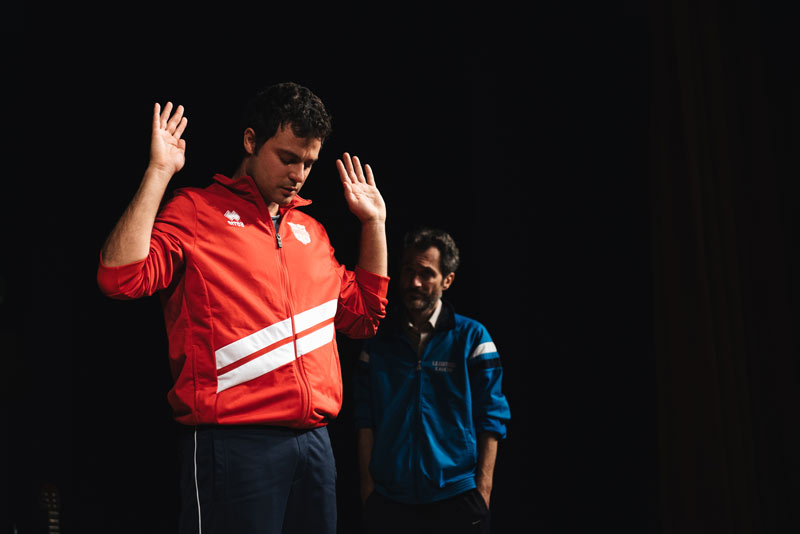
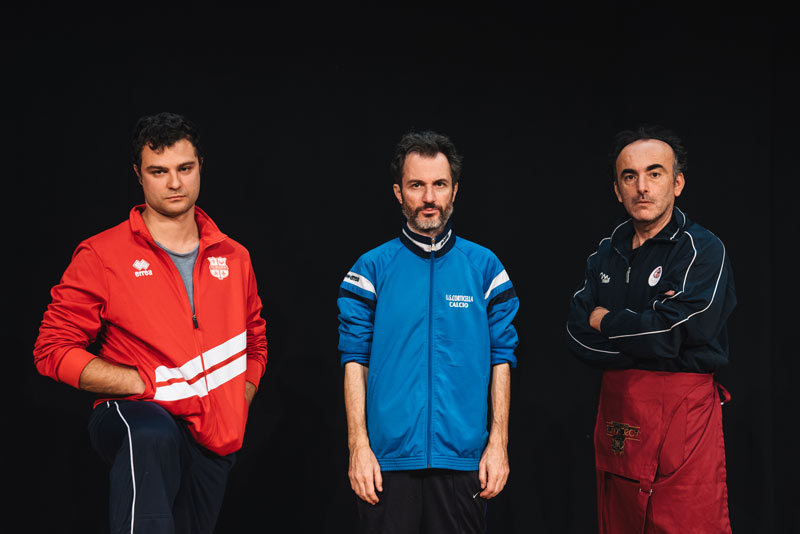
Three men in an Italian prison cell: an elderly Sicilian former Mafia hitman; a young North African man framed for a drug offense; and a middle-aged man—possibly Jewish, mysterious, and cultured—imprisoned following a sudden, violent impulse. What binds—and what divides—these three men who hail from different shores of the Mediterranean, yet find themselves serving time in a tiny cell for such vastly different crimes?
Penned by Ignazio De Francesco—an expert on both the italian prison system and the Middle East—and adapted for the stage by Alessandro Berti (marking the third collaboration between the two, following the successful Leila della Tempesta in 2017 and Simeone e Samir in 2019), Joseph & Bros upends stereotypes. It pierces the veil of the present to explore ancient Middle Eastern brotherhoods, complex faiths and identities, the personal responsibility of the individual, and the obligation to historical truth. It addresses these themes by using the confines of prison as a litmus test for society at large—an accelerator of the emotions, ideas, and conflicts that the three men must ultimately confront.
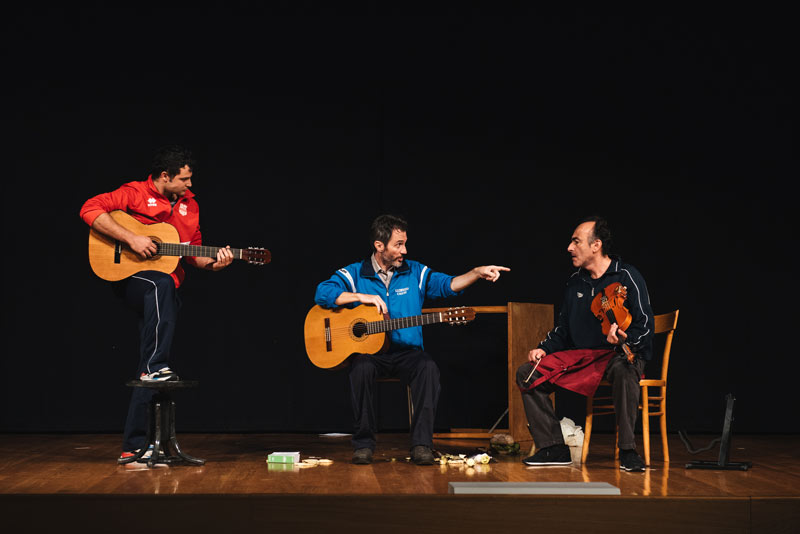
The biblical (and Quranic) story of Joseph and his brothers serves as the symbolic backdrop to the narrative, representing the mythic crux of the possibilities and challenges inherent in a Mediterranean brotherhood. This ancient tale of a fraught coexistence—involving attempted murder, kidnapping, and the sale of a brother into slavery—inspires the role-playing games of three inmates. Their cell becomes a synecdoche and a metaphor for today’s Palestinian territories, divided by a wall; these are games of brotherhood to be attempted and resumed after every failure—games made extreme and essential by the forced proximity of cell life. The most surprising and engrossing of these games is the formation of an actual prison folk band: the three inmates dub themselves “Joseph & Bros,” using music to accompany the unfolding chapters of the story right up to a genuine, intimate final concert.
As is always the case with Berti’s work, the staging relies on rigorous acting that eschews histrionics and self-indulgence. With the set design stripped away—mirroring the bareness of the cell—what remains are the flesh-and-blood bodies of three men: their scents, their movements, their voices—men who are scarred but unbroken. This directorial simplicity elevates the actors’ craft and allows the text to speak for itself, leaving the audience with seeds of reflection and emotion to ponder long after they return home.
“The text dramatizes the convergence of three worlds—seemingly worlds apart in terms of ethnic, religious, cultural, and social backgrounds—that find common ground within the tiny nine-square-meter space of a prison cell, where the three men spend long years of incarceration. Ahmad is a drug trafficker, Salvo a Mafia hitman, and Gadi a killer ‘by chance.’ Then there is Samuel—absent from the stage yet communicating with the trio from afar—an innocent man betrayed by those closest to him, paying the price for a crime he did not commit.
It is a reflection on wounded brotherhood and on the violence that springs from the human heart (specifically the male heart), spilling over from the microcosm of personal relationships into the macrocosm of the history of relations between peoples. Furthermore, it is a meditation on the possibility of giving and receiving forgiveness—and on how that forgiveness, which is ultimately a recognition of the ‘Other,’ allows for rebirth beyond betrayal and violence. The backdrop is the biblical story of Joseph and his brothers (Genesis 37–45)—a narrative also found in the Quran (Surah 12) and one that has inspired extraordinary developments in Jewish, Christian, and Islamic literature. The plot, events, and dialogue are the result of an original creative process grounded in extensive research, including exchanges with current and former inmates (Alessandro, Catia, Fabrizio, Franco, Giovanni, Joseph, Luciano, Max, Samad, Vincenzo) and statements from state witnesses—most notably Tommaso Buscetta, Rosario Trubba, and Maurizio Prestieri. Finally, the work draws on private conversations with experts in the field of the prison system: Nadia Assueri, Giancarlo Bregantini, Adolfo Ceretti, Diana Gran Dall’Olio, Maria Inglese, Maurizio Millo, and Germana Verdeoliva.” Ignazio de Francesco